How to Monitor Canton Validator Performance: Key Metrics Explained
Written by
Yuliia Borivets
,
Marketing Specialist
Published
Most Canton validators don't have a clean view of their own performance. The data exists on-chain, but accessing it in a usable form — structured, timely, and in the right context — is harder than it sounds. There's no single dashboard handed to you on day one. Pulling meaningful Canton Network validator performance metrics typically means navigating raw blockchain data, building custom queries, or piecing together numbers from multiple sources that weren't designed to talk to each other.
And even when operators do get access to the numbers, a second problem appears: knowing which ones actually signal node health versus which ones are misleading in isolation. A strong reward total can hide a sync fee problem. A stable daily average can mask an hourly pattern that points to recurring infrastructure issues. The data is hard to get — and once you have it, it still requires the right lens to interpret it.
This guide covers both problems: which metrics to track, and how to track them automatically without technical overhead.
In this guide you'll learn:
KPIs every Canton validator should be tracking
How missed rounds function as the earliest available diagnostic signal
What unrealized USD gains and losses tell finance teams that reward totals alone do not
Why hourly reward averages reveal patterns that daily summaries mask
How bandwidth and resource usage tie directly to sync fee levels
How to automate monitoring across all five metrics with real-time alerts and scheduled reporting
The Metrics Canton Network Validators Should Actually Be Tracking
Most validators track at least some data. The gap is not between operators who look at data and those who do not — it is between those tracking the right combination of metrics and those who have optimised around an incomplete picture. The five metrics below represent the minimum viable KPI set.
1. Rewards Minted vs. Sync Fees Burned
The most fundamental pairing in validator economics is gross rewards versus sync fees — and they need to be read together, not in isolation.
Validator rewards represent the tokens minted for successful consensus participation. Sync fees are the cost of keeping a node synchronized with the network — they burn tokens and are expressed as a negative value. Viewing them side by side on an hourly basis reveals the true economic pattern of a node in a way that daily or weekly summaries obscure.
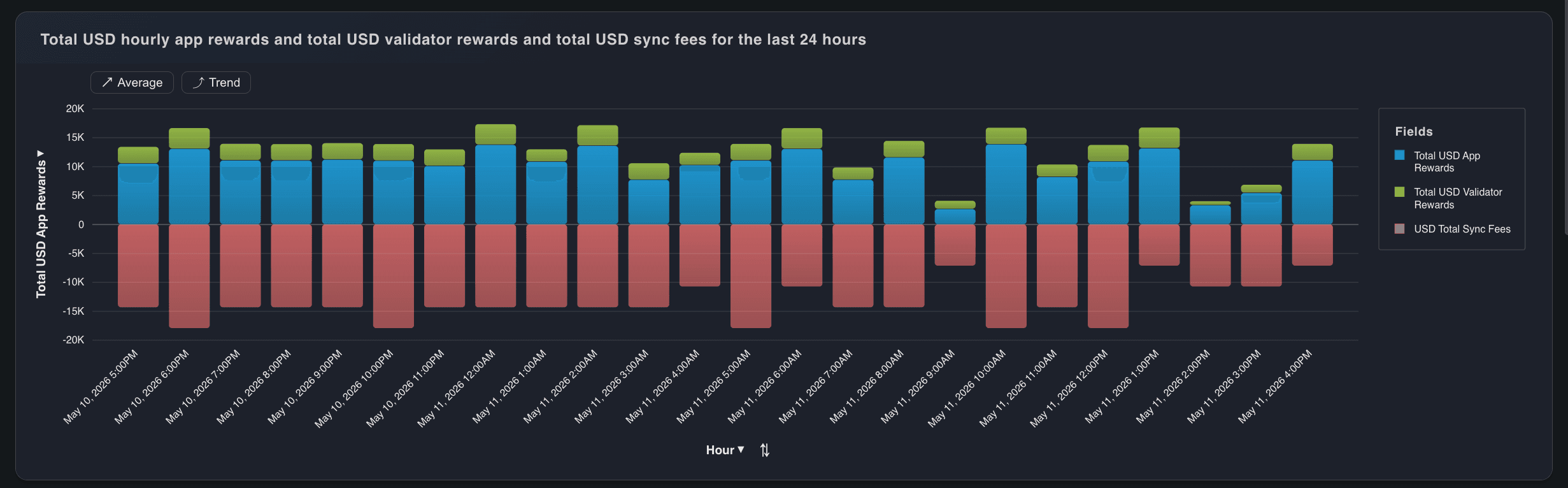
As visible in the hourly dashboard above, rewards (blue bars, positive) and sync fees (red bars, negative) fluctuate significantly across a 24-hour window. Some hours show strong net positive positions; others are compressed by fee spikes that nearly offset the reward earned. The USD validator reward layer (yellow-green, positive) adds further texture by showing how the validator's own reward contribution stacks against the broader app reward pool.
2. Unrealized USD Gains and Losses
This is the metric finance and operations teams actually care about — and it's often the one missing from standard validator dashboards.
Unrealized USD gains and losses by day give the real economic position of the node in fiat terms, accounting for both the token rewards earned and the market value at the time. A validator with strong gross rewards but elevated sync fees may be significantly underperforming a leaner, less active node once the USD position is calculated.
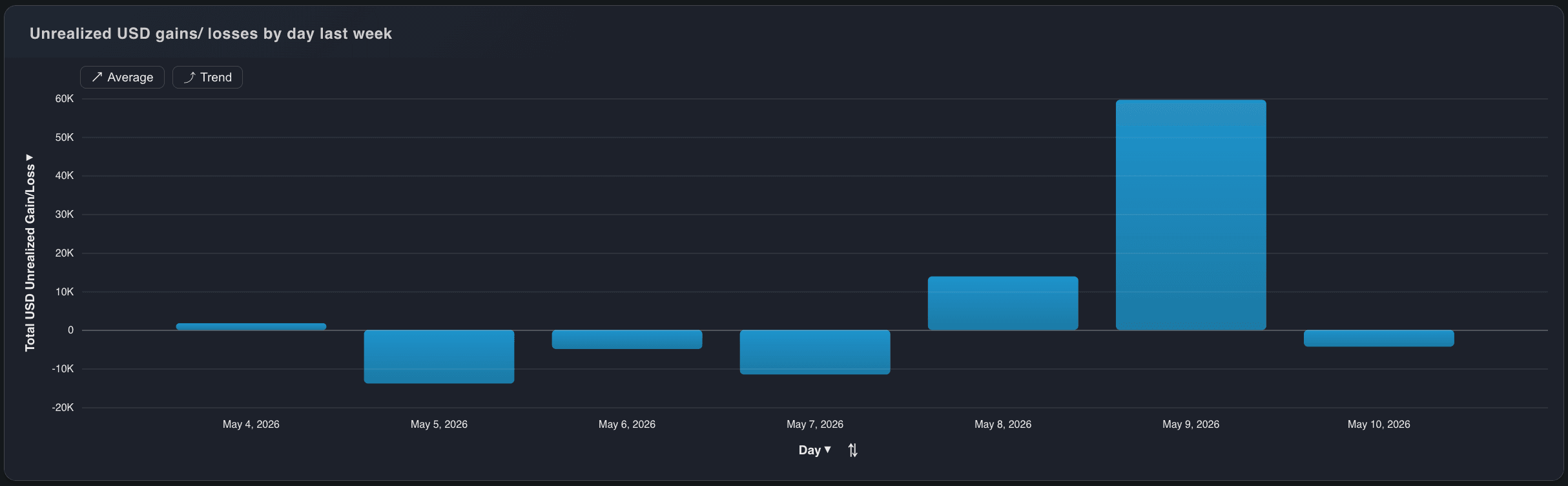
The weekly chart above illustrates why daily granularity matters here: May 9 shows an unrealized gain approaching $60K, while May 5 and May 7 register losses in the -$10K to -$12K range. Without day-level visibility, those swings get averaged out of view and the true volatility of the economic position is invisible to the teams who need to manage it.
For finance teams, this metric directly supports month-end close, treasury reporting, and any internal or regulatory requirement to represent the validator's economic contribution in USD terms. Automating validator reward reporting on Canton Network ensures this data is captured accurately at the cutoff — not reconstructed from screenshots after the fact.
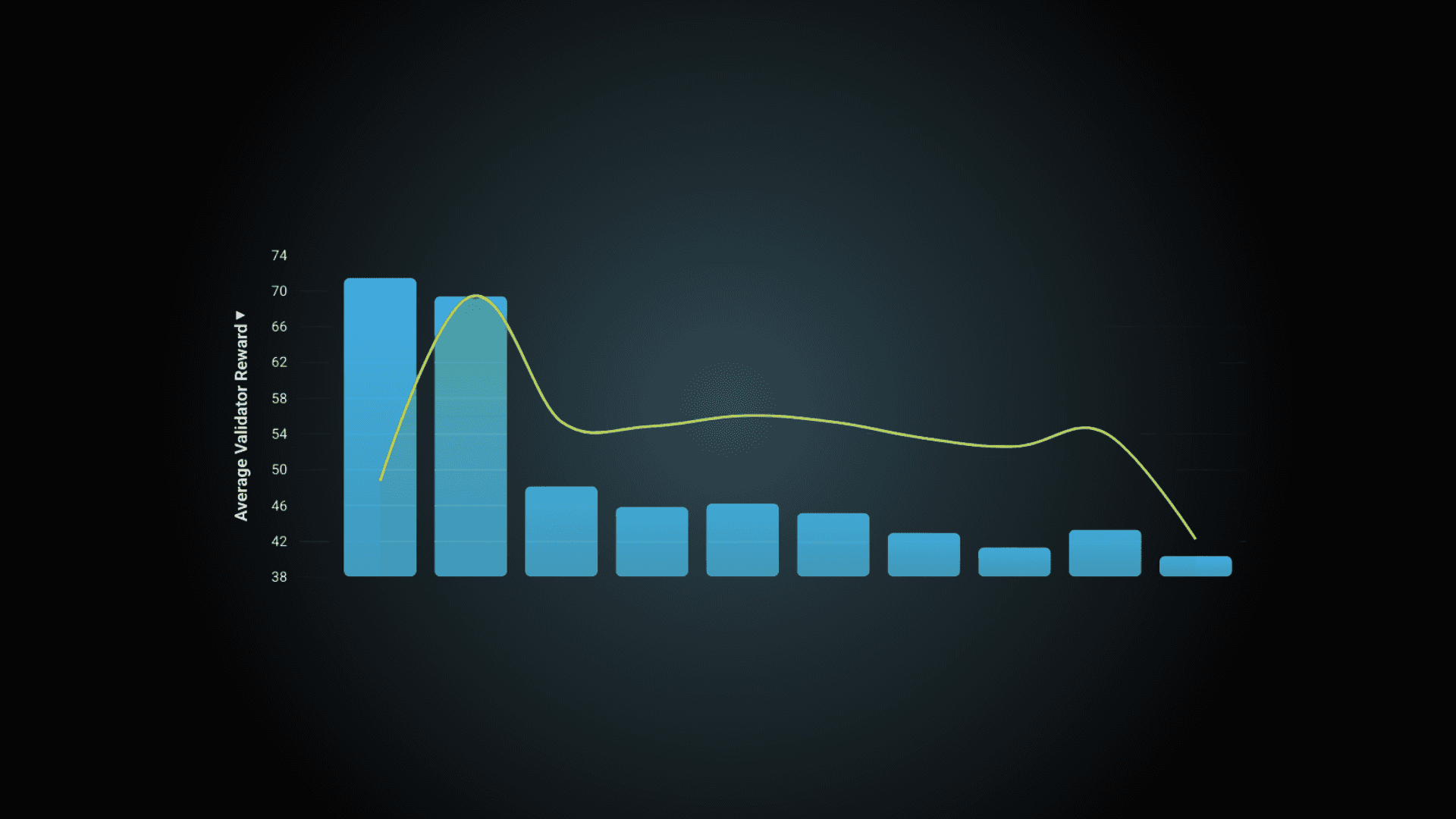
3. Average Validator Reward by Hour of Day
Daily averages are misleading. A node that earns heavily in the morning and barely participates in the evening will report a healthy daily average — even though the intraday distribution points to a structural issue or a configuration worth investigating.
Hourly reward averages, plotted over the course of a full week, reveal the performance envelope of a node: what its peak windows look like, where recurring low-reward periods fall, and whether deviations from baseline are time-of-day patterns or genuine anomalies.
This metric is particularly useful during onboarding and post-configuration reviews, where operators need to verify that a node is participating as expected across all hours, not just during peak network activity.
4. Bandwidth and Resource Usage
How much Canton Network bandwidth a validator consumes relative to the rewards it earns is one of the clearest operational signals available — and it's one of the most actionable.
Sync fees are the direct financial expression of bandwidth consumption. A node that is over-consuming bandwidth will see elevated sync fees before that cost shows up meaningfully in the net reward position. That lag — between the bandwidth spike and the economic consequence — is the intervention window. Operators who track bandwidth and sync fee trends together can catch a resource usage problem before it starts compressing their USD position.
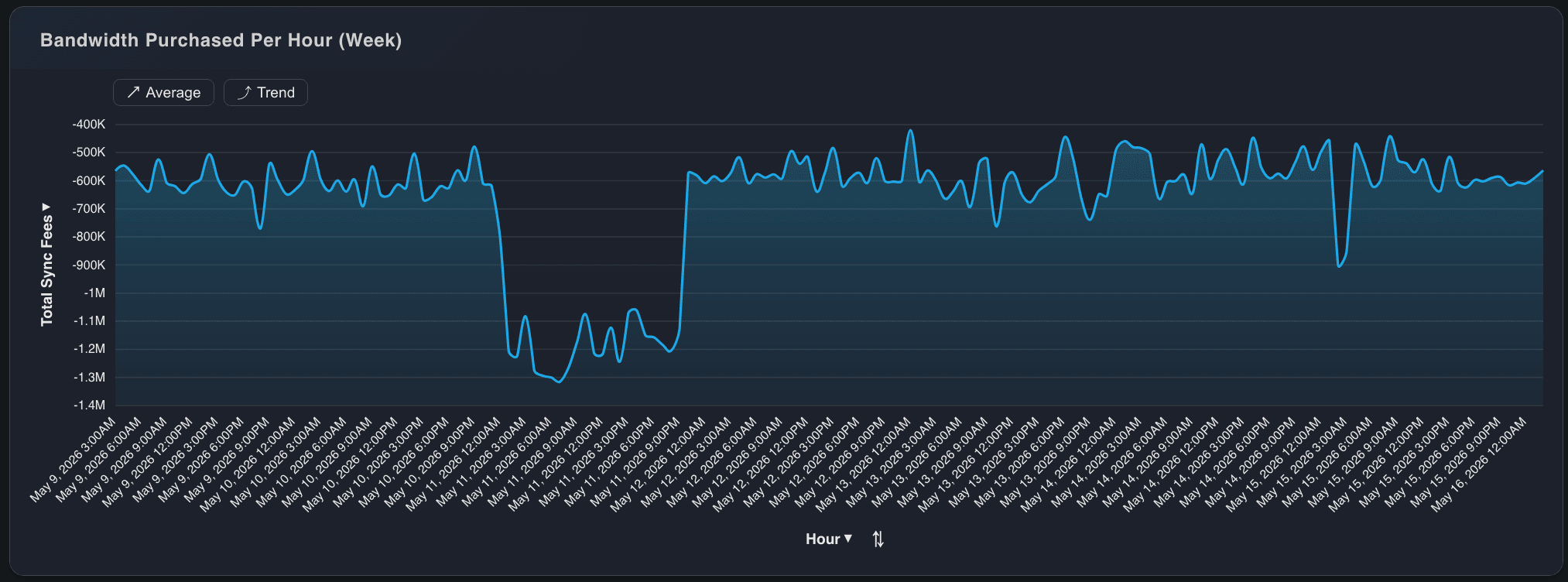
The weekly bandwidth chart above (Bandwidth Purchased Per Hour, May 9–16) shows why this matters. Sync fees hold relatively stable in the -$500K to -$600K range for most of the week, but between May 10 and May 12 they spike to -$1.3M — more than double the baseline — before recovering. That spike had an economic cost. Operators who were watching bandwidth in real time had the opportunity to investigate the moment the deviation appeared. Those relying on weekly summaries discovered it after the fact.
Tracking this metric connects directly to Canton Network analytics that go beyond block-level data to surface resource usage patterns at the operational level.
5. Missed Rounds
Missed rounds are the earliest diagnostic signal available to Canton validators, and they're the one metric no operator should be monitoring manually.
A missed round means a scheduled consensus participation window was not completed. It precedes any reward impact — which means it's the fastest way to detect a node-level problem before it compounds into missed rewards, elevated sync fees, or a degraded network position.
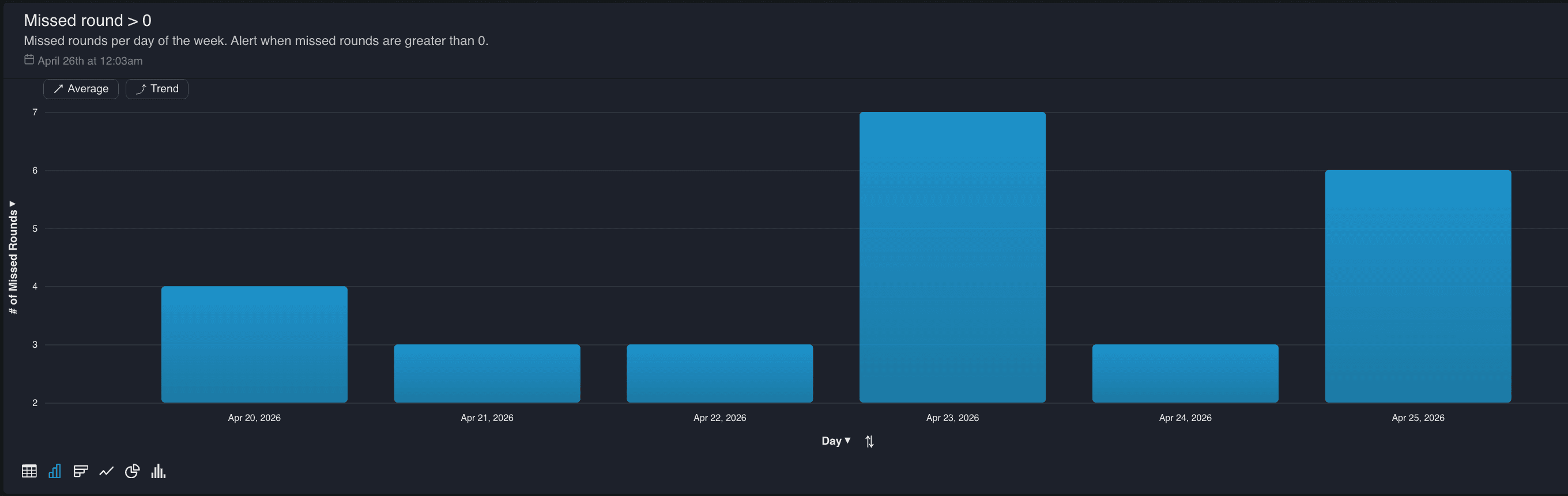
The missed rounds chart above (April 20–25) shows a pattern that warrants attention: 4 missed rounds on April 20, holding at 3 for the next two days, spiking to 7 on April 23, and then 6 on April 25. None of those days had zero missed rounds. For a validator targeting consistent consensus participation, that's a persistent signal — not a one-day anomaly.
How to Track Canton Validator KPIs Automatically
Manual dashboard monitoring is a reasonable starting point. It becomes a liability as validator operations scale, as reporting requirements grow, and as the window between a problem occurring and a team discovering it begins to have real economic consequences.
24/7 Automated Monitoring. Sync Insights continuously tracks all five metrics above — rewards, sync fees, unrealized gains/losses, bandwidth, and missed rounds — in real time. The monitoring runs whether or not anyone is logged in. Thresholds can be configured for each metric, and the system flags deviations the moment they occur.
Scheduled Reporting. For finance teams, compliance officers, and executive stakeholders who need structured data at regular intervals, reports can be scheduled to run automatically. Month-end reward summaries, weekly net position reports, and daily anomaly digests all run on a defined schedule — at the exact time required, in the correct time zone — without anyone having to be present to initiate them. This directly addresses the operational risk described in the automated validator reward reporting post: missed cutoffs, manual transcription errors, and availability dependencies disappear.
Real-Time Alerts. The most time-sensitive metric — missed rounds — requires a real-time alert, not a scheduled report. Sync Insights supports threshold-based alerting across all tracked metrics, so teams receive a notification the moment a condition is met, not hours or days later.
Example: An Alert for Missed Rounds
Sync Insights allows operators to set real-time alerts for missed rounds, with configurable thresholds so that a single missed round triggers a different response from a sustained pattern across multiple days.
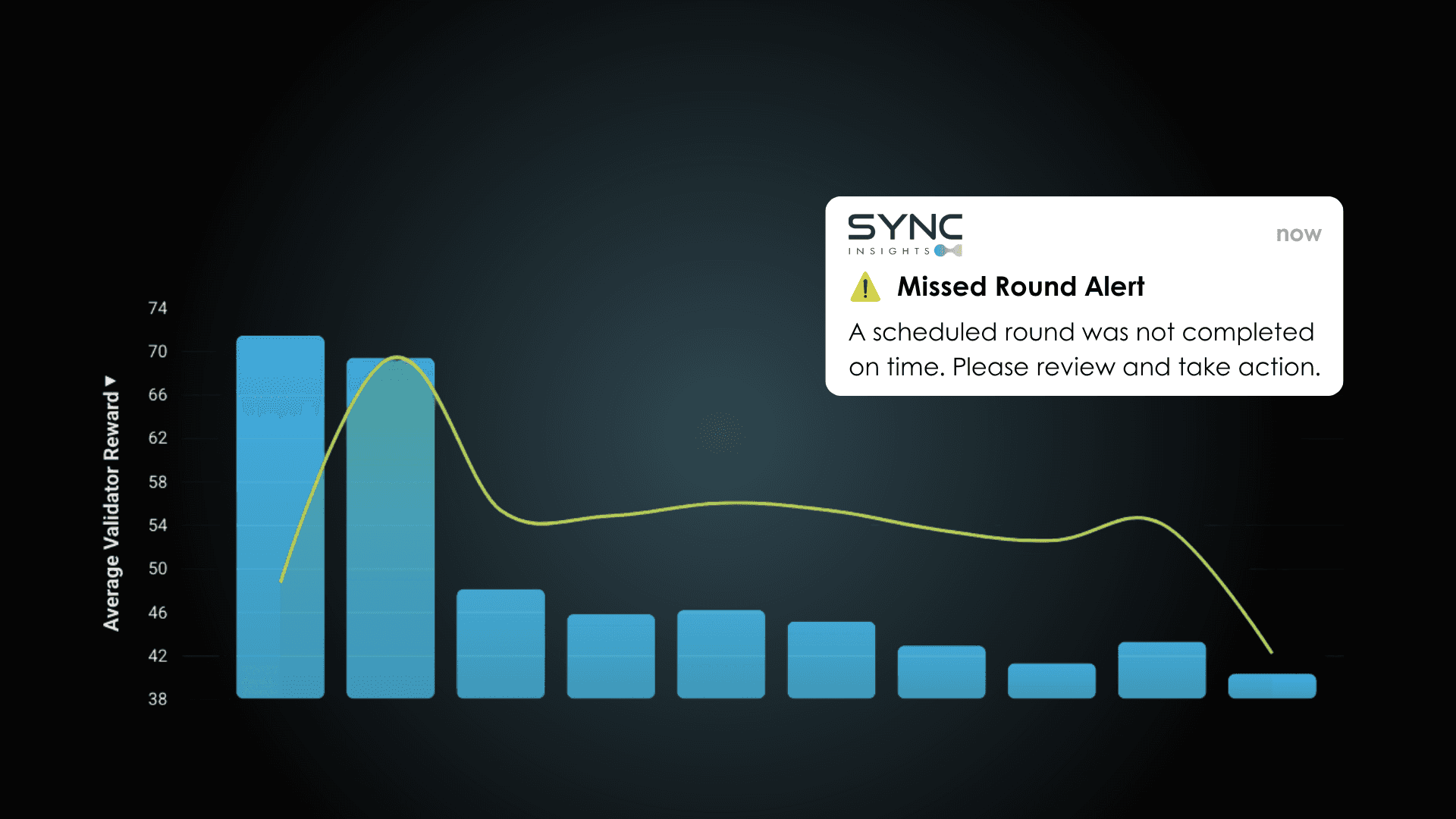
The moment a round is missed, Sync Insights fires a push notification that reads: "A scheduled round was not completed on time. Please review and take action." The alert surfaces instantly, giving your operations team the window to investigate before a single missed round becomes a pattern of seven.
FAQ: Common Questions About Canton Validator Performance
What is a normal validator reward on Canton Network?
Validator rewards on Canton Network vary based on participation rate, network activity, and sync fee levels. Rather than a single benchmark, the most useful reference point is your own 30-day rolling average — consistent performance close to that average indicates healthy node behaviour.
What causes Canton validator rewards to drop?
Canton validator reward drops are typically caused by missed rounds, increased sync fees, reduced network activity, or a combination of all three. Comparing your node's reward trend against network-wide data helps determine whether the cause is node-specific or a broader network event. Sync Insights' Canton Network analytics lets you run this comparison in plain language without needing a data analyst.
What are Canton sync fees and why do they matter?
Sync fees are costs incurred by Canton validators for network synchronisation. They are deducted from gross rewards, meaning high or rising sync fees can reduce net profitability even when reward volumes look healthy. Tracking sync fees alongside rewards — as shown in the Sync Insights Validator Performance dashboard — gives the true performance picture that gross reward figures alone cannot provide.
How do I know if a missed round is my fault or the network's?
If multiple validators show missed rounds in the same time window, the cause is likely a network event rather than a node-level issue. Monitoring network-wide participation data alongside your own node metrics is the most reliable way to make this distinction quickly. Sync Insights' real-time monitoring provides both views simultaneously, so you can correlate your node's behaviour against broader network patterns without switching between tools.
How often should Canton validators check their metrics?
Critical metrics like missed rounds and hourly rewards should be monitored in near real time with automated alerts for threshold breaches. Reward trends and sync fee analysis are best reviewed daily and over a 30-day rolling window to distinguish short-term variance from sustained changes. The three-mode monitoring approach — real-time alerts, daily digests, and automated reporting — covers all three time horizons without requiring anyone to check everything manually.
Know Your Numbers, Keep Your Node Healthy
Canton Network validators generate more performance data than most teams have the bandwidth to interpret — which is exactly why tracking the right metrics matters more than tracking all of them. Net CC position, missed rounds, unrealized USD gains and losses, average hourly reward profiles, and bandwidth consumption together give a complete, layered picture of node health that no single metric can provide on its own. Operators who track Canton Network validator performance metrics systematically and automatically are the ones who catch problems before they compound, optimise their node configurations based on real patterns rather than intuition, and build the kind of audit-ready data trail that institutional operations now require.